Some interesting realizations (ie. a rant on elevators and capacity limitations)
The area that I will be staying in this summer is a beautiful location, with easy access to the train into the city but also teeming with green space and wild life (I may need to make a chipmunk tracker of some kind – they are EVERYWHERE). I also got a brief tour of the studio space that I will be working in for the majority of this summer. The studio itself is shared among several conservators of varying specialties, including objects and paintings.
For larger pieces of art, sculpture in particular, there is a satellite studio for oversized art in one of the conservators residence, as the studio in White Plains is on the 6th floor of a building with very limited elevator capacity. I think that this makes a lot of sense, and may not be an aspect of this work that people realize could prove to be a challenge when trying to establish a private conservation practice. Unlike many larger institutions in which freight elevators are slightly more common and can accommodate large prices of artwork, many commercial and historic buildings are lucky to even have an elevator as an option.
For this practice in particular, had one of the conservators not had the ability to convert an area of her residence into a studio, it would have limited the work the practice could take on based off of whether it could be treated onsite or if it could come to the studio.
Beyond the thought of challenging elevator capacity, I also learned more about some of the projects that I will be working on this summer. In addition to the silver polishing treatment and anoxic IPM research, I will also be working on repairing a ceramic ginger jar lid (it has now been broken twice, and because of this I will need to figure out how to deal with the previous repairs), as well as an African beaded headdress that is in desperate need of some cleaning.
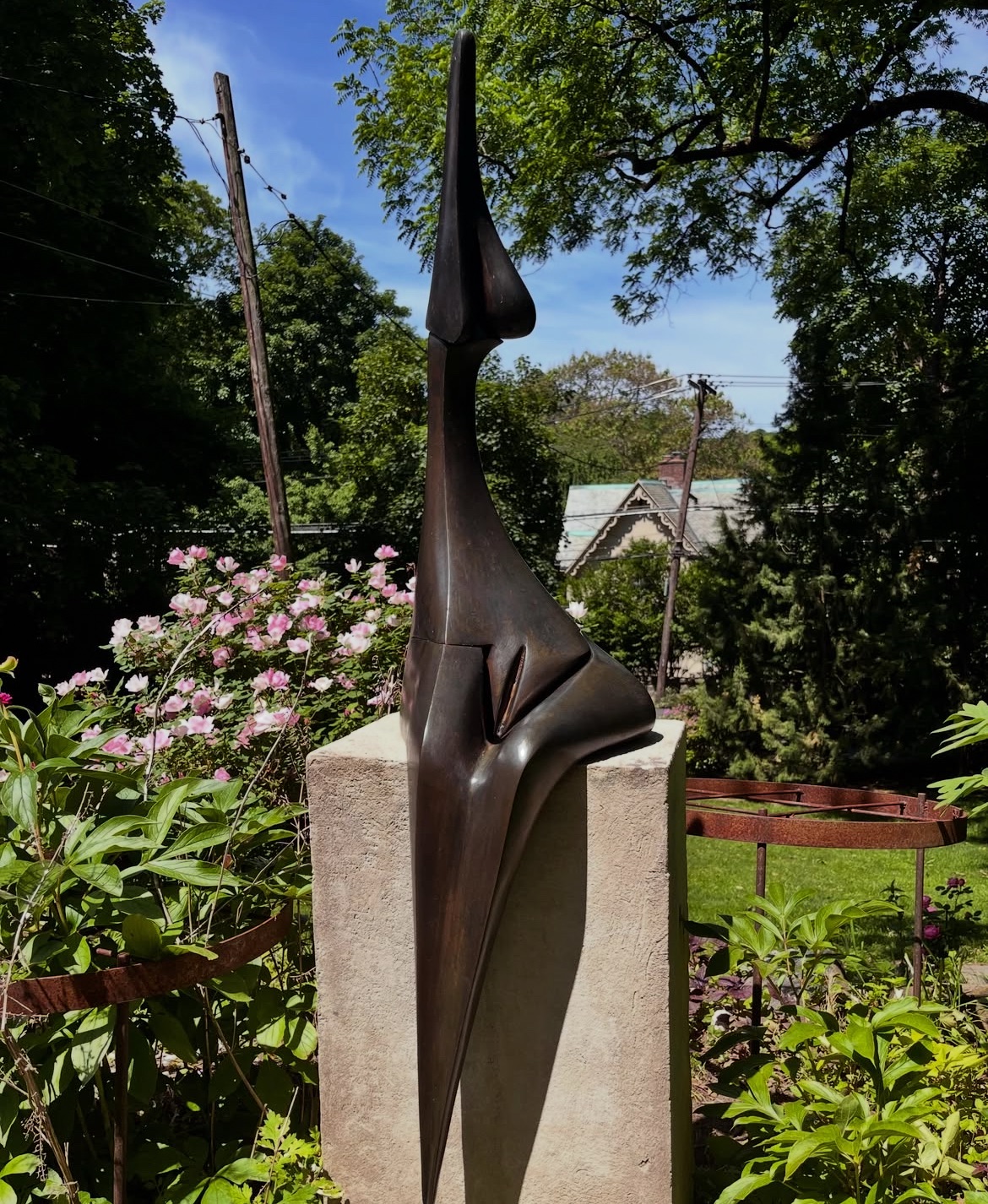
The afternoon of my arrival was spent settling in, and in one way work began right away, as my employer had an outdoor sculpture that had recently been treated with hot wax that needed to then be treated with cold wax. Here is what I learned…
- Once the sculpture is cleaned, hot wax is applied to outdoor sculptures (in this case the base material was bronze) as a protective coating. Hot wax is applied in solid form when the sculpture has been heated, and heat is then further applied to ensure that the wax seeps into the pores of the metal.
- After the hot wax treatment has been applied and has cooled, a cold wax layer is applied annually to ensure the longevity of the hot wax treatment. To apply the cold wax treatment, we used stiff brushes to scoop the wax (suspended in a solvent) and paint it onto the sculpture. Once the entire sculpture was coated we let the wax sit until it had hardened. Once hardened we took soft cloths and buffed the wax, rubbing the sculpture with small circular motions until the wax was no longer tacky and the sculpture was shiny in appearance.
I found this practice to be very interesting, and am curious as to the effects of different climates on outdoor sculpture works. For example, (this is really specific) how might the treatment/ upkeep process look different for a sculpture housed in a green house? or in a salt air environment like Florida?
To the point of the salt air environment, I am also curious as to how this would impact indoor sculptures as they too would be in some way impacted via the salt air brought in from the HVAC units or windows.
Anyways, that’s all for now.


Leave a Reply